
August 2018
AN AFTERNOON IN AUSTRIA
We were driving through the Croatian countryside when a winding lineup of cars on the side of the road caught our attention. Wondering what the holdup might be, Chris and I pulled up a map and realized it was a queue to enter Plitvice Lakes National Park — the park we had decided to skip in favour of Krka National Park, near Split. We were pleased with our decision as we whizzed by on our way to Austria, and later that evening, back to Germany.

We had been travelling together for almost two weeks, having started at his home in Munich, then made our way through Slovenia to Bosnia and Herzegovina, and Croatia. Chris and I shook hands for the first time at hostel in Nicaragua in 2017 and have been friends ever since. Driving past sheep farms, wild pig warnings, and what appeared to be police busting a van full of migrants, I was thrilled we still enjoyed each other’s company after so many hours on the road together.
We had a quick lunch outside a bus stop in Ljubljana, crossed into Austria, and then parked ourselves at a beach on the eastern shore of Lake Wörthersee.
Day 11: Krka to Munich, via Austria (cont’d)
KLAGENFURT AM WÖRTHERSEE
I’m blessed to have access to some pretty stunning lakes and mountains where I live, but as I basked in the sun at Strandbad Klagenfurt’s private beach, I wasn’t sure I had seen anything in Canada compared. For an entrance fee of just €3, inclusive of parking, visitors are treated to sparkling turquoise waters against a backdrop of mountains — the Gurktal Alps and the Karawanks. We spent several hours here, jumping back and forth between the sand, the lake and the gelato stand before pressing on to Salzburg for the afternoon.


SALZBURG ALDSTADT
It may have been one of the most well-dressed cities I had ever been in. From the latest fashions to more traditional outfits, most people on the streets of Salzburg were put together with intention from head to toe. Unfortunately, our tour of this world famous city was cursory, as we had to make it to Munich that night.
We began with a walk through the Aldstadt, a world heritage site of baroque and medieval buildings, the birthplace of the Salzburg’s favourite son and — of particular interest to me as a musical lover — the site of several scenes from the Sound of Music. Our first stop was the stately Residenzplatz Square, said to be the largest and most beautiful of five built under Prince-Archbishop Wolf Dietrich von Raitenau:


According to the city’s website, 55 medieval buildings were torn down to build the square, whose grandiose fountain features four horses, three dolphins and a Triton, and is among “the one of the most significant baroque monuments in Europe.” Plus, Maria and the von Trapp children sing while they pass it during an outing in the beloved film.
 From there, we made our way down to the Salzach River for views of the Hohensalzburg Fortress atop the Festungsberg mountain. Its construction began in 1077 yet astonishingly, it remains the largest fully preserved castle in Central Europe. Its current appearance, however, dates back to the early 1500s and the museum it now houses features many of its still untouched original rooms. Click here for information on ticket prices, opening hours and transportation options.
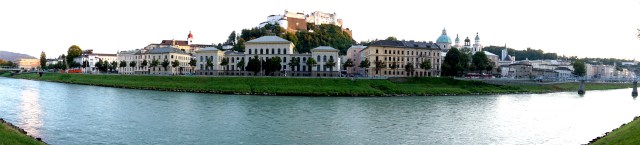
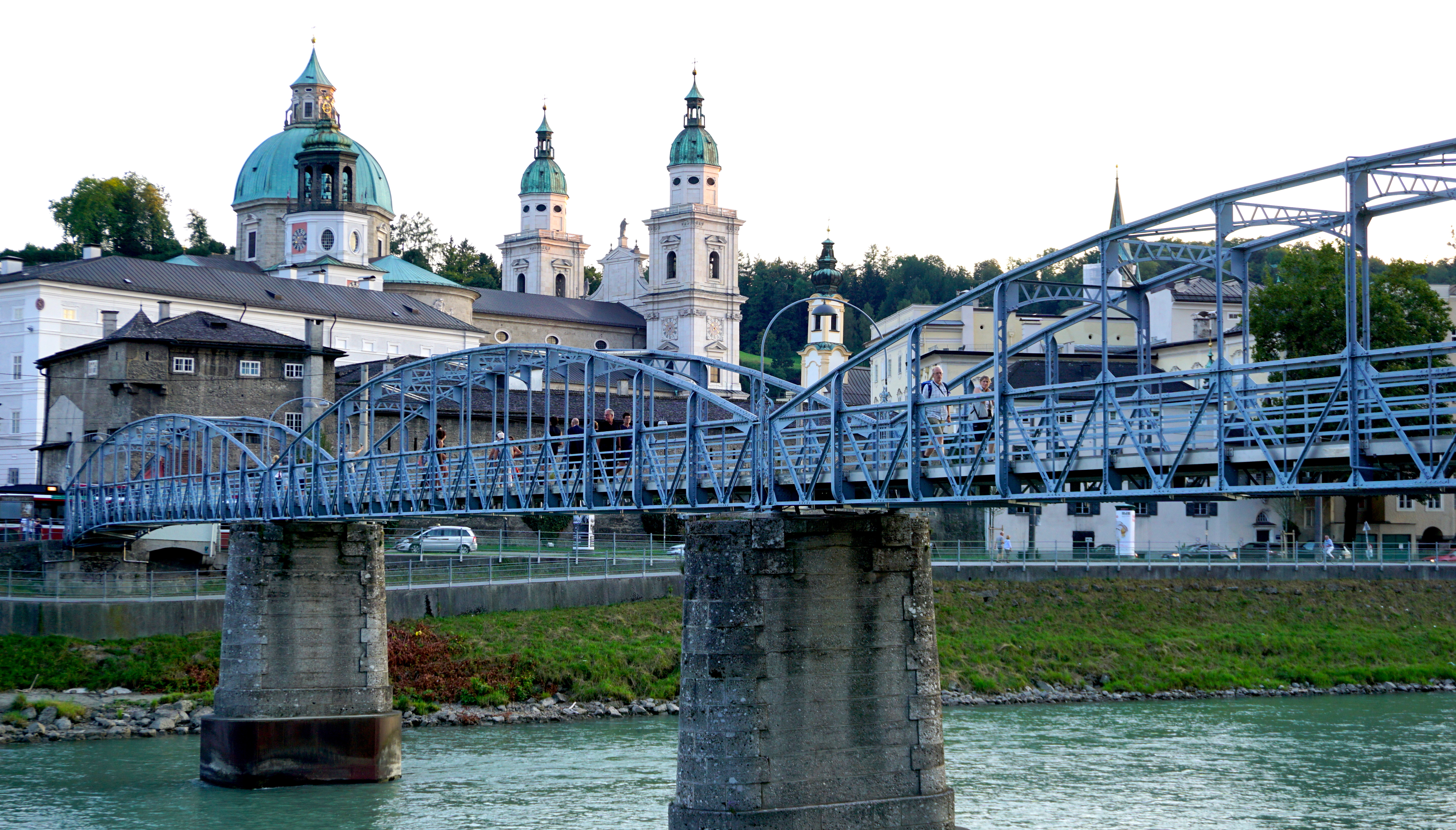 A stroll along the Salzach River is an attraction on its own, especially as sunset starts to cast its glow on the pink, yellow and blue buildings, whose appearances are strictly regulated by the city. From here, you can catch beautiful views of the fortress, the Salzburg Cathedral, the remains of one of several 500-year-old fortification walls built around the Old Town, as well as the signature Mozartsteg footbridge, which also appeared in the Sound of Music.
 Next, it was off to the birthplace of the legendary composer while there was still light out. Mozart was born at Hagenauer Haus in 1956, but pressed for time, we didn’t go into the distinguished yellow building. It’s a bit of a pilgrimage for music lovers and history buffs around the world, now housing a collection of certificates, letters, portraits and memorabilia associated with the maestro. I wonder Mozart would rate this introduction to the U.K.-based Classic FM’s list of his top 10 life-changing pieces:
With extremes at both ends of the emotional and musical scales, Mozart is author of some of the most uplifting and soul-crushing music ever written.
We paid our respects to the statue of Wolfgang in Mozartplatz, meant to be erected on the 50th anniversary of his death, but delayed a year due to the discovery of a Roman mosaic in the ground, the city website states. We had just enough time before dinner for a jaunt through the rest of Getreidegasse, an old street whose mix of colourful and traditional inns, cafés, houses and shops are too picture-perfect for a tourist to miss. Here, you can stack up on everything Austria, from Mozart rubber duckies to hand-stitched dolls in bright dirndls.


We parked ourselves just outside the Museum of Nature for dinner at Escobar, where we scarfed down some delectable pulled pork and craft Austrian witbier. Lamenting that there was so much more to left to see in Salzburg (like the Hellbrunn Palace and its trick fountains), Chris and I packed ourselves back into the car. After all, we had an important date in southeastern Germany that involved a lot of beer, leather and pretzels.
Click here to follow my adventure back to Bavaria.

 Elizabeth Around the World