
August 2018
‘YOU ARE MY WITNESS’
I’m often asked by friends and acquaintances for travel recommendations. I’m flattered when anyone seeks my opinion, and since I can only draw from personal experience, my answers haven’t changed for years: Ethiopia. Uzbekistan. Morocco. Turkey. I didn’t think, as I steamed in 36°C, stuck in inexplicable rural traffic, that I would soon be adding Bosnia and Herzegovina to my list of all-time favourites.

While this Balkan country lacks the breadth of established ‘tourist attractions’ that giants like Morocco are famous for, travelling there – for me – was a visceral and humanizing experience. BiH is a naturally beautiful country; it has mouth-watering food and eclectic markets, but the scars of its political history are so visible, they evoke a discomfort and thoughtfulness that contextualizes one’s own experiences. In far too recent years, it has been subjected to abominable violence and cruelty, including genocide, ethnic cleansing and rape as a weapon of war. It can be an eye-opening and educational if you come with an open mind. BiH is a country calls you to be a witness, recognizing that not all travel is about light reading and pretty things.

Day Four (continued): Zagreb to Sarajevo
I hit the road for Sarajevo on Aug. 10, 2018, the fourth day of a road trip that began in Germany, and included Austria, Slovenia and Croatia. I was travelling from Zagreb with Chris, a friend from Munich. We were hoping to reach the Bosnian capital within five hours, but instead found ourselves idling bumper-to-bumper in the Croatian countryside in sweltering heat, with the check engine light flashing ominously. Two hours later, the source of the jam was revealed: a truck accident that took ages to clear off the road.


The line at the border looked even longer. Unable to read the signs, we had no idea which queue we were supposed to be in with our foreign passports, so we took a gamble. We picked the wrong one, but instead of making us backtrack, the officials kindly let us pass with an entry tax of 91 Bosnian Marks and a 21 EUR green card.
POZDRAV IZ SARAJEVA
I had enjoyed out extended trip through the countryside, which was rich and green. Scattered industry, including gravel mining and agriculture, broke up the hilly landscape and separated rural towns, each of which had a very small mosque. Sheep skins and metal work were displayed for sale on roadsides, and piles of fresh plums were available everywhere. We reached Sarajevo after dark, and just managed to navigate its narrow, steeply-inclined streets to our hotel downtown.

We had arrived well past our check-in time, but the owners of the Vila Una didn’t mind. The small hotel is run by a very warm elderly couple who all but hugged us as we rolled our suitcases in, welcoming us with a postcard that read, ‘Pozdrav iz Sarajeva’ – greetings from Sarajevo. In a mix of Bosnian and a little bit of German, they asked where we were from. Chris answered Germany, and I, Canada, and they enthusiastically showed us all their framed photos of politicians and celebrities who had stayed in their hotel over the years. There was a Canadian maple leaf pin by the front desk, which the owner highlighted enthusiastically.
BAŠČARŠIJA AT NIGHT
After assuring and reassuring our hosts that we were comfortable and everything met our expectations, Chris and I headed down to Baščaršija, the old bazaar that was once the city’s historical and cultural core. It’s immediately identifiable by the large fountain at its entrance, called Sebilj, behind which is the restaurant we chose to have dinner at: Hodžić 2

I had been reading for weeks about BiH’s cuisine and couldn’t wait to get my hands on a plate of ćevapi, little bite-sized sausages often served with raw onion and pita bread. The country is a meat-lover’s paradise – it was smokey, chewy and delicious. I live a mostly vegetarian life, but when I travel, I throw all the rules out the window. You’ll eat very well in Sarajevo restaurants for KM10 (about CAD 7.50).
We waded through the crowds of Baščaršija at night, inhaling the smoke of grilling meat, cigarettes and shisha. Music ranging from electronica to Bosnian folk poured from the speakers of bars and bakeries. People sat on curbs and sidewalks to be part of the action, and around 10 p.m., a display of fireworks went off somewhere behind one of the downtown mosques. We stopped for shisha at Caffe bar El Kazbah, and bought a few rounds of Sarajevsko Pivo before calling it a night. The Sarajevo Brewery, founded in 1864, has a colourful history whose early production is described in amusing detail in this 1930 Yugoslav Journal article.


Day Five: Sarajevo
We started our day with a plate of fresh plums, bread, jam, eggs and sausage at the small basement dining room in Vila Una. The plan was to start at the sites that required driving and work our way back into town.
SARAJEVO TUNNEL MUSEUM
The Sarajevo Tunnel Museum was our first stop, about half an hour’s drive southwest of the city centre. The walls of the above-ground structure are riddled with bullet holes – leftovers of the longest siege in modern-day history, in which more than 13,000 people were killed under daily rounds of heavy artillery.
The Bosnian War lasted from 1992 to 1995, part of the breakup of the former Yugoslavia. The entrance to the tunnel is through the cellar of a private home and it runs about one kilometre under the city’s airport runway. Between its construction in 1993 and the end of the Siege of Sarajevo, declared by the Bosnian government in February 1996, it was the only way out of the city. An estimated 1 million people escaped through the Tunnel of Hope and some 20 million tons of food were brought in through it. Serbian forces knew the tunnel existed, but its location was carefully guarded, even by journalists.


At just under five feet from floor to ceiling and about one metre across, the dimly-lit tunnel is uncomfortable at best. I had to crouch to pass through the 20-metre length that’s still open to the public and I forced myself to imagine, painfully, what it would have been like to traverse its full length at the peak of the siege. Loved ones murdered, homes in ruins – the Tunnel Museum spares no detail, particularly in its display of weapons used against civilians during the war.
SARAJEVO ROSES
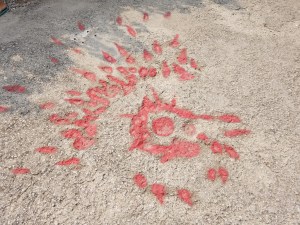 In the courtyard of the home on top of the tunnel, you’ll find one of about 200 Sarajevo Roses – painted red memorials made out of the distinct and gruesome scarring of grenades exploding on concrete. Tens of thousands of grenades were dropped on the city during the war, during which about 100,000 people were killed and more than 2 million were displaced. The roses mark spots of mass casualty, and in 2016, a documentary on the 24-year conflict in Bosnia, told through the experience of survivors, was named after them.
 We drove back into town for a walk through Baščaršija in the light of day. There’s a lot less smoke and a lot more children, and the shops are teeming with shiny things: copper and silver plates, tea sets, ornate hookahs and jewellery. We walked to Gazi Husrev Bey’s Bezistan, a covered bazaar with an eerily magnetizing golden glow, whose structure was built around 1540.


THE SPITE HOUSE
We continued through the city centre streets, taking note of the Sarajevo Roses we saw and the bullet holes that razed the walls of many buildings. We passed the unmistakable red and yellow-striped Vijećnica – Sarajevo’s City Hall – crossed the Miljacka River on the Šeher Ćehaja Bridge (the ‘mayor’s bridge’) and made our way to the famous Inat Kuća.


While the Inat Kuća is now a restaurant, the history of the iconic house is defined by the doggedness of its original owner. In the late 1890s, the home stood where the Vijećnica is now, but in order to build the new city hall, the Austro-Hungarians of the day needed to demolish it. Two neighbouring inns were destroyed, but the proprietor refused multiple compensation offers from the royals. Eventually, he persuaded them to pay him a bag of gold ducats and to rebuild his house brick by brick on the other side of the Miljacka River. That structure still stands, and the owner’s obstinacy has since earned it the nickname, ‘The Spite House.’
READ MORE: Do you know the story of Inat Kuca? Sarajevo Times
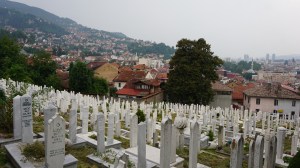 From the Inat Kuća, we climbed the steep city hills to the Alifakovac cemetary. The graveyard contains more than 500 tombstones and is the resting place of many influential Sarajevans, as well as foreigners who died on their journey through the city. According to Destination Sarajevo, it’s for this reason that Alifakovac is also sometimes called the Musafir (foreigner or traveller) Cemetery. It’s a bit of a climb, but the view is stunning from atop the hill, and there’s a poetry to the roses that grow between the graves – roses, being the city’s chosen way to immortalize the scars of its past.

THE ASSASSINATION THAT STARTED WORLD WAR I
Back at the banks of the Miljacka River, one bridge east of the Šeher Ćehaja Bridge, is the Latin Bridge. It’s visually unremarkable, but at its north end is the site of one of the world’s most notable assassinations – that of Archduke Franz Ferdinand of Austria.
The 1914 shooting of the heir presumptive to the Austro-Hungarian throne and his wife, the Duchess of Hohenberg, spurred the July Crisis – a series of tense diplomatic exchanges that led to the outbreak of World War I. It would become the deadliest conflict in human history, with an estimated 9 million killed in combat, 5 million civilian deaths, and countless more by the ensuing spread of the Spanish flu and genocides led by the Ottoman Empire.
Despite its historical significance, little more marks the spot than a small plaque, whose unpretentious inscription reads, “From this place on June 28, 1914, Gavrilo Princip assassinated their heir to the Austro-Hungarian throne Franz Ferdinand and his wife Sofia.” The Museum of Sarajevo 1878-1918 was build inside the former shop before which the assassination took place.

‘YOU ARE MY WITNESS’
There was no emotional reprieve in our next stop – Galerija 11/07/95, an exhibit memorializing the 8,372 missing and murdered people taken in the Srebrenica massacre. This genocide in July of 1995 primarily took the lives of Bosniak Muslim men and boys around the small mountain town in the eastern half of the country, although the bodies of some women and girls were also discovered. Thousands of women from Srebrenica were also taken to be raped and abused as part of an insidious campaign of terror and ethnic cleansing, carried out by Bosnian Serb forces of the Army of the Republika Srpska and Serb paramilitary units. The total number of women raped during the war is unknown due to the number of unreported cases, but some estimates run as high as 50,000.
 As if these crimes against humanity weren’t gutting enough, it’s important to note that the Srebrenica massacre took place after the United Nations had put the town under its protection. Despite their commitments, international forces and allies failed to respond to the attack as it unfolded. The Dutch – who had been ultimately assigned to protect the enclave – were later declared responsible for failing to prevent at least 300 deaths at the Hague, and by their own supreme court.
The gallery contains powerful video, audio and photographic imagery of the massacre and its victims, enough to move anyone to tears. I would describe it as an exhibit of the compassion and strength of Bosnians and a heart-wrenching showcase of humanity’s failures that everyone should see. Bosnians want you to see it too – inscribed on the gallery’s ticket is:
Ti si moj svjedok. Sen benim sahidimsin. You are my witness.
A SARAJEVO STREET PARTY
We made our way back to the Baščaršija as it grew dark. Instead of ćevapi, we ordered two steaming plates of burek from a small restaurant deep in the bazaar. It remains, to this day, one of the most delicious food memories I have: warm spinach, cheese and potato wrapped into thin filo pastry rolls drenched in a heavenly cream. For dessert, we picked up a box of sweets from Baklava Shop Locum.ba, and for less than 6Km (CAD 4), gorged ourselves on baklava, buttery kadaif, pituljice and orah ruzice. For a list of delectable Bosnian desserts to know before you go, click here.


We wandered outside Baščaršija for an evening drink, and were drawn to Cafe Bar Opera. It was standing room-only on a Saturday, and its speakers pounded with what Chris and I presumed was very popular Bosnian heavy metal. The smoke in the air was as thick as the face makeup in the room, and I revelled in the intensity and joy of it all (I’m from a city known for its well-rounded blandness).
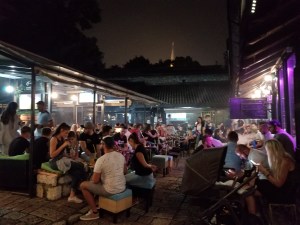 We walked around to find a similar venue, but stumbled instead into a street party with hundreds of people behind Hostel Scandic. I wish we were in on the cause for celebration, but maybe there was none – maybe this was just a Saturday in Sarajevo. We had a drink and observed. It was hard to believe these partygoers, about my age, had known war in their lifetimes and were old enough to remember the sound of the grenades.
Day Five: Sarajevo to Dubrovnik
 After an intense two days in the city, we made our way south to Croatia. We had a few stops to make in BiH before Dubrovnik and were joined by some unexpected guests on the way.
MOSTAR
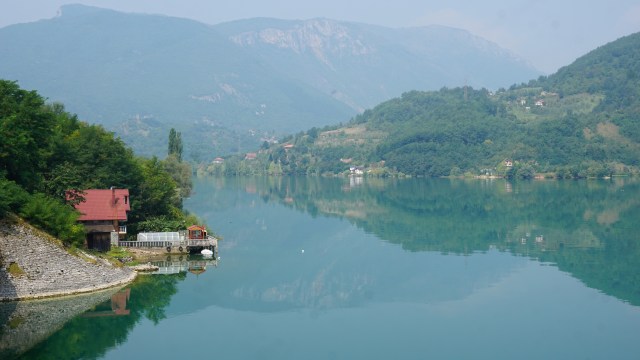
It’s about two hours to Mostar from Sarajevo, past the sparkling turquoise Jablanica Lake. It’s one of the most photogenic bodies of water I’ve ever seen, even if it is an artificial construction. The road south is equally inviting: gazebos of sticks and flowers on front lawns, fresh fruit piled into attractive displays, and the softest sheep furs hanging on wooden racks for purchase.
The historic city of Mostar lies in the Lower Neretva Valley, split by the Neretva River, which flows all the way through BiH and Croatia to the Adriatic Sea. It’s known for its iconic Stari Most or Old Bridge – a reconstruction of the stone bridge built by the Turks in 1566 and destroyed by war in 1993. The bridge was a feat of 16th century engineering, but the area itself has been occupied since time immemorial.
On a Sunday in August, the old stone city was teeming with tourists from all over the world, crowds we had not seen in Sarajevo. We picked the least busy restaurant and waited a long time for lunch anyway, and got our change in three different currencies. Once we saw what we came to see, we moved on. Don’t skip Mostar – it’s super beautiful – just be prepared for the traffic.


KRAVICA WATERFALLS
We took a turn southwest to visit the Kravica Waterfalls, considered one of the most stunning cascades in the Balkans. The natural reserve is in the Hercegovina part of the country on the Trebižat River, which falls 28 metres into a freshwater pool. It costs Km 20 for an adult entry and there’s a restaurant and coffee bar on site.
Shuttles are available to take visitors to the base of the falls, but not wanting to wait in line or pay for one, Chris and I walked the 20-minute distance ourselves. This was both smart and stupid: we got there more quickly, but the uphill return in the scorching sun wasn’t pleasant. We visited at Kravica’s low discharge season (the falls are fullest in the spring), but the 120-metre crescent of blue-green was stunning anyway. We had a hard time finding a place to put our towels down, the area was so busy with families and picnickers:


SWITCHBACKS AND HITCHHIKERS
We lingered as long as we could but needed to check into our campsite outside of Dubrovnik before dark. We took the somewhat treacherous M17.3 south, and I gripped the armrest tightly as we swerved around countless kilometres of narrow switchback in Hercegovina.
We were stopped by police at one point, but had broken no rules. We couldn’t overcome the language barrier, and in the end, drove off without incident. A few kilometres later, we were flagged down again – this time by Polish backpackers. It was blistering and dry in this part of the country, so we picked them up and cranked the air conditioning for them. It turns out Tomac and Sebastien, both students, had been standing there for hours, unwilling to accept a ride if it wasn’t offered for free.
I don’t remember where we dropped them off, but it was somewhere before the Croatian border. Click here to follow the final leg of our the trip to Dubrovnik and Split, before returning to Germany.
Know Before You Go
Travel Tips:
- The tap water in Sarajevo is potable.
- At the time of posting, there were no ATMs near the Bosnian border. If you’re entering from Croatia, you’ll need to withdraw local currency there.
- If you’re looking for souvenirs for your trip, save your shopping for Mostar. The trinkets may be a bit more expensive, but there are many more options and the product quality is a little better. They also take all currencies in Mostar, rather than only the Bosnian Mark.
- Arrive early at Kravica to beat the lunch-hour crowds and secure a parking spot. Bring a waterproof bag for your valuables so you can enjoy the pool and the falls without worrying about them.
Where to Stay:
- Villa Una is a warm and friendly place to stay with excellent customer service but very average amenities. Breakfast and WiFi are included in the price of 106km per night for a double bed. Make a reservation at villauna@hotmail.com or at +387 33 580 290.

 Elizabeth Around the World